Dishwasher Not Draining? 7 Causes and How to Fix Each One
Dishwasher not draining? These 7 causes cover 95% of cases — clogged filter, blocked hose, garbage disposal, faulty pump and more. Most fixed in under 20 minutes.
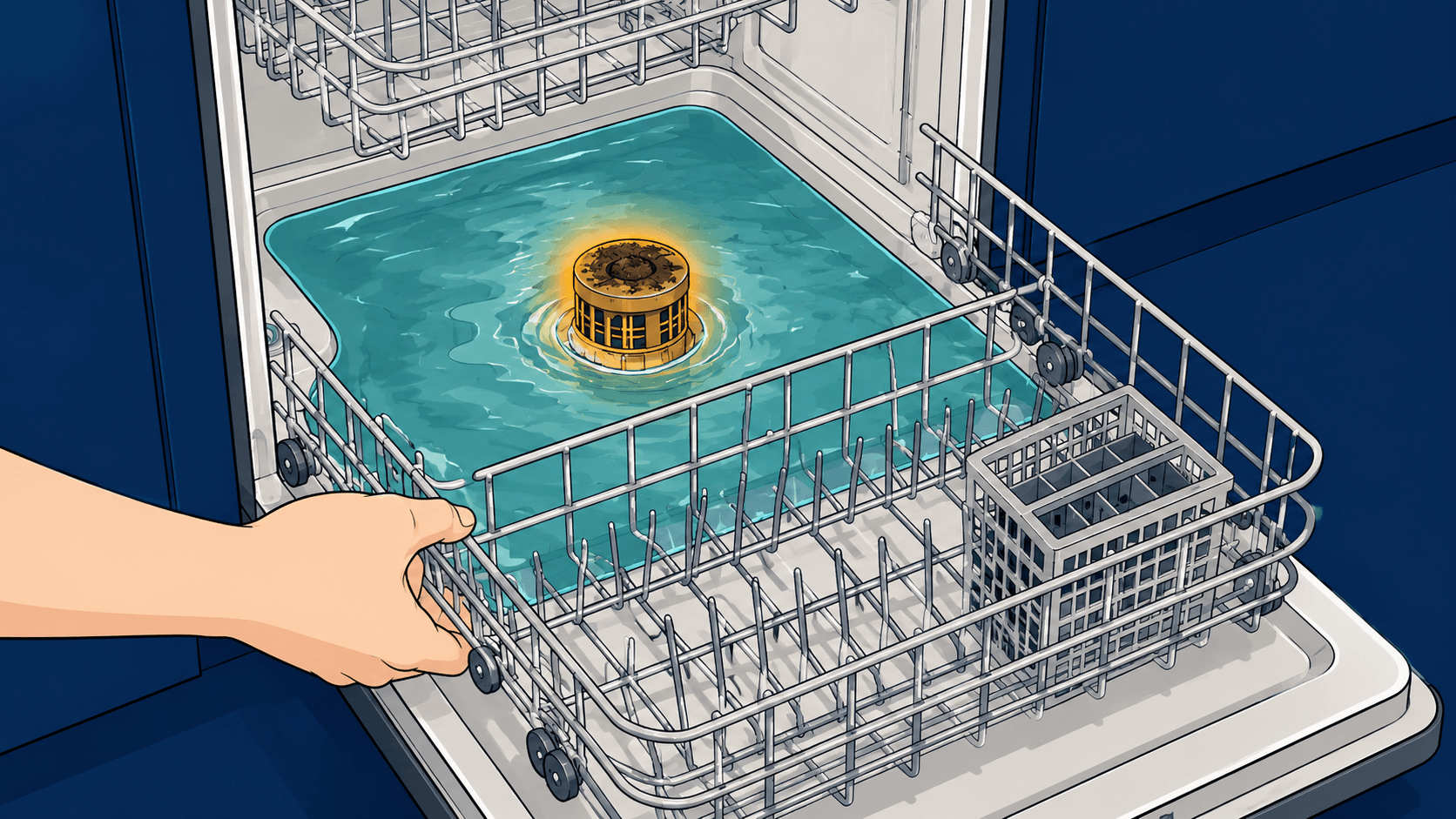
I stood in front of our 2018 Frigidaire Gallery with my hands on my hips for a solid minute before Karen finally said “just clean the filter, Marcus” — and she was right, like she usually is. Three inches of standing water, a full cycle completed, dishes still dirty. I’d assumed pump failure. It was a filter I hadn’t touched in fourteen months.
A dishwasher that won’t drain is almost always caused by one of seven things: a clogged drain filter, a kinked or blocked drain hose, a garbage disposal connection issue, a clogged air gap, a failed drain pump, a blocked drain valve, or a problem with the door latch mid-cycle. Clean the filter first — it solves this in about 60% of cases.
| Cause | Symptom Clue | DIY-Fixable? | Estimated Cost |
|---|---|---|---|
| Clogged drain filter | Standing water, cloudy film on dishes | Yes | $0 |
| Kinked or blocked drain hose | Water drains slowly or not at all | Yes | $0–$25 |
| Garbage disposal connection | Water backs up into sink during cycle | Yes | $0 |
| Clogged air gap | Water out of air gap cap on counter | Yes | $0 |
| Faulty drain pump | Humming sound, no drainage | Maybe | $35–$85 part |
| Blocked drain valve/solenoid | Intermittent drainage failure | Maybe | $20–$60 part |
| Door latch or mid-cycle interrupt | Cycle stops before drain phase | Yes | $0–$30 |
Cause 1: Clogged drain filter — the one everyone skips first
This is where I start every single time now, after the Frigidaire incident. On most dishwashers made after 2010, the self-cleaning grinder was replaced by a manual filter that catches food particles. Whirlpool, Bosch, KitchenAid, LG, Samsung — they all use this system. GE still uses a hard food disposer on some models, which is why GE owners see this less often.
The filter sits at the bottom of the tub, usually under the lower spray arm. On most Bosch models it’s a twist-lock cylinder sitting inside a flat mesh screen — both pieces need to come out. On Whirlpool and Maytag it’s a single cylindrical filter that pulls up and twists counterclockwise about a quarter turn.
Pull the bottom rack out. Locate the filter assembly — it looks like a small round cap in the center or rear of the tub floor. Twist counterclockwise and lift. Rinse it under hot running water. If you see a gray, greasy film that doesn’t rinse off easily, scrub it with a soft brush and dish soap. On our Frigidaire, I had to use an old toothbrush to get into the mesh — the buildup was almost paste-like after 14 months of neglect. Reinstall firmly — a loose filter lets debris into the pump and creates a worse problem down the line.
Clean the filter every 30–60 days if you run the dishwasher daily. Karen added it to her maintenance log between oil changes and furnace filter swaps. That’s the right cadence.
Cause 2: Kinked or blocked drain hose
The drain hose runs from the dishwasher’s pump outlet to either the garbage disposal inlet or the sink drain tailpiece. It’s usually corrugated plastic, about 5/8 inch inner diameter, and it’s routed under the sink. On older installations — and our 1987 ranch has a few of these still — the hose gets zip-tied to the back of the cabinet and forgotten for a decade.
Two failure modes: a kink from someone storing things under the sink and pushing the hose flat, or a partial clog from grease buildup inside the hose itself. Open the cabinet under the sink and physically trace the hose from where it exits the dishwasher to where it connects at the disposal or drain. A kinked hose will show an obvious bend or compression. Straighten it and re-route it so it has a gentle curve, not a sharp angle.
For a clog: disconnect the hose at the disposal or drain end — have a towel ready, some water will come out. Blow through the hose. If you feel significant resistance, there’s a partial blockage. Run a flexible bottle brush through it or use a garden hose to flush it from the disposal end.
One thing most guides miss: the drain hose should have a high loop — routed up near the underside of the counter before coming back down to the drain connection. Without this high loop, dirty water from the sink can siphon back into the dishwasher. On our 2018 Frigidaire install, the previous owner’s plumber had skipped the high loop entirely. We had intermittent drainage issues for two years before I figured that out.
Cause 3: Garbage disposal connection blocked or not punched through
If your dishwasher drains into a garbage disposal, two things can cause a drainage problem here.
First: the disposal is clogged or full. Run the disposal for 30 seconds before starting the dishwasher. If it’s jammed, use the Allen wrench socket at the bottom center of the disposal (usually 1/4 inch) to manually rotate the shredder plate. Then press the reset button on the bottom of the unit. This is the scenario most people hit in January, right after New Year’s cooking overloads the disposal with holiday food scraps.
Second: a new garbage disposal was installed and the knockout plug was never removed. A new disposal comes with a plastic knockout plug in the dishwasher inlet port — it’s designed to be punched out during installation. If whoever installed the disposal forgot, that plug blocks every drop of water from the dishwasher. I’ve seen this twice. The symptom is complete non-drainage that appears suddenly right after a disposal replacement.
Fix: disconnect the drain hose from the disposal inlet. Look inside the inlet with a flashlight. If you see a flat plastic disc, take a flathead screwdriver and a hammer and knock it out from inside. Retrieve the plug from inside the disposal barrel before reconnecting — it’ll destroy the disposal if left in there.
Cause 4: Clogged air gap
If your sink has a small chrome or plastic cap on the countertop near the faucet — about the size of a quarter, positioned between the faucet and the sink edge — that’s the air gap. Not every installation has one; some areas require them by code, others permit the high-loop method instead. Raleigh requires them on new installs.
When the air gap clogs with mineral deposits or food debris, water from the dishwasher can’t push through it and either backs up into the dishwasher or spurts out of the air gap cap onto your counter. To clean it: unscrew or pop off the decorative cap. Inside you’ll find a plastic body with two hose connections — one from the dishwasher, one going to the disposal or drain. Disconnect the hoses and use a small bottle brush or pipe cleaner to clear the internal passage.
The most common clog point is right at the connection elbow. On our old install I found what looked like solidified grease the texture of candle wax — a hot-water flush alone wouldn’t have touched it. Annual cleaning prevents it entirely.
Cause 5: Faulty drain pump — how to test before you buy anything
This is where I’d have made the expensive mistake on the Frigidaire if Karen hadn’t spoken up. A failed drain pump is a real cause — but it’s the fourth or fifth most likely, not the first. The drain pump is a small electric motor with an impeller that forces water out through the drain hose. When it fails, you’ll typically hear silence where there should be a pumping sound, or a low humming that doesn’t produce drainage.
To test without buying anything first: start a cycle and let it run to the drain phase — the last few minutes. Open the door carefully and listen. If you hear humming but no water movement, the motor is running but the impeller is likely jammed. With the dishwasher unplugged, remove the filter and look down into the sump with a flashlight. Try to spin the impeller with your finger — carefully, edges can be sharp. I found half of a broken toothpick in our 2015 Maytag’s pump impeller, wedged at exactly the wrong angle.
If the impeller spins freely but still no drainage, use a multimeter set to resistance (Ω) and test the pump motor terminals. On most residential dishwasher drain pumps the resistance should read between 5–30 ohms. A reading of OL (open loop/infinite resistance) means the motor windings have failed — replace the pump.
Drain pump assemblies for common brands run $35–$85 on PartSelect or RepairClinic. Bosch drain pumps (part series 263740) run around $55. Whirlpool/Maytag pumps (W10348269 and equivalents) are around $40. LG drain pump assemblies tend to be $65–$85 because they include the motor housing. Replacement requires pulling the dishwasher out and tilting it on its back — about 90 minutes if you haven’t done it before.
Cause 6: Drain valve solenoid failure — the intermittent one
Some older dishwashers — pre-2015 GE models especially — use a drain valve controlled by a solenoid rather than a dedicated drain pump. The solenoid opens a flap to allow water to flow into the pump. When it fails, the valve stays closed and nothing drains.
The diagnostic clue is intermittency: the dishwasher drains fine sometimes, fails other times. A consistently bad pump doesn’t fix itself between cycles. That pattern of inconsistency is what separates solenoid failure from pump failure.
To test: disconnect power. Locate the drain valve assembly — on most GE dishwashers it’s at the left rear of the tub floor, connected by two wires. Disconnect the wires and test the solenoid coil with a multimeter. You’re looking for resistance between 200–500 ohms. Outside that range or an OL reading means the solenoid has failed. Replacements run $20–$60 and are model-specific — have the model number from the door jamb sticker ready before ordering.
Cause 7: Interrupted cycle or door latch issue
If the dishwasher door is opened mid-cycle — even briefly — most modern dishwashers stop and don’t resume from where they left off. The pump phase may never run. You open the door an hour later: standing water, convinced something is broken. Nothing is broken.
A worn or misaligned door latch that doesn’t register as fully closed can cause the control board to abort the cycle mid-run. On Samsung and LG models I’ve seen this create error codes — Samsung’s 5E or OE code, LG’s OE code — that look more alarming than they are. Close the door firmly and run a new short cycle. If it drains correctly, you had a cycle interruption. If the latch is worn and not clicking into place, a replacement door latch is $15–$30 and takes about 20 minutes to swap.
Difficulty and cost summary
| Task | Difficulty | DIY Cost | Pro Cost | Worth DIY? |
|---|---|---|---|---|
| Clean drain filter | Easy | $0 | $75–$125 | Always |
| Clear kinked hose | Easy | $0 | $75–$125 | Always |
| Clear garbage disposal | Easy | $0 | $100–$150 | Always |
| Clean air gap | Easy | $0 | $75–$100 | Always |
| Replace drain pump | Moderate | $40–$85 | $180–$300 | Yes if under 8 yrs old |
| Replace drain solenoid | Moderate | $20–$60 | $150–$250 | Yes |
| Replace door latch | Easy | $15–$30 | $100–$150 | Always |
When to call a technician
Call a licensed appliance technician if you’ve tested the drain pump with a multimeter and confirmed motor winding failure on a dishwasher over 10 years old — at that point the repair cost approaches replacement cost and a tech can give you an honest assessment. Also call if water is backing up into the sink drain even after clearing the disposal and drain hose, which suggests a blockage in the main drain line — that’s a plumber’s job. Never attempt to repair the drain pump while the dishwasher is still connected to power; the pump capacitor can hold a charge after disconnection.
Frequently asked questions
Why is my dishwasher not draining?
The most common cause is a clogged drain filter that hasn’t been cleaned in months or years. Behind that: a kinked or blocked drain hose, a clogged garbage disposal connection, or a faulty drain pump. Start with the filter — it solves the problem in about 60% of cases and takes five minutes.
How do I manually drain a dishwasher?
Remove the bottom rack and use towels, a sponge, or a turkey baster to remove standing water. For faster removal, a wet/dry shop vac positioned at the filter opening pulls water out quickly. Once the water is gone you can diagnose the cause without standing in it.
Can a clogged garbage disposal cause a dishwasher not to drain?
Yes, and it’s more common than people think. The dishwasher drain hose connects directly to the disposal inlet — a clogged disposal backs water straight into the dishwasher. Run and clear the disposal before assuming the dishwasher has a problem. If you recently installed a new disposal, check for the knockout plug in the dishwasher inlet port — it’s a flat plastic disc that must be removed during installation.
How much does it cost to fix a dishwasher that won’t drain?
If the fix is a clogged filter, kinked hose, or air gap: $0. Drain pump replacement runs $40–$85 in parts if you do it yourself, or $180–$300 with professional labor. In my experience, about 80% of dishwasher drainage problems are resolved by the homeowner without spending anything.
Is it worth repairing a dishwasher that won’t drain?
If the dishwasher is under 8 years old and the repair is a pump or solenoid, yes — part cost is a fraction of replacement. Over 12 years old with multiple symptoms, the math tilts toward a new unit. A basic new dishwasher starts around $400; a drain pump job on a good machine costs $50–$85 in parts.
Why does my dishwasher have standing water after the cycle?
A small amount of standing water (less than a cup) in the filter well is normal on most machines — it keeps the door seals from drying out. Water covering the full tub floor after a completed cycle is not normal and indicates a drainage problem. The filter is the first thing to check.
Can I use drain cleaner in my dishwasher?
No. Drain cleaner damages rubber seals, plastic components, and spray arms. It’s also ineffective because the blockage is almost never in a location drain cleaner can reach. Use hot water and manual cleaning only.
My Bosch dishwasher won’t drain — is it different from other brands?
Bosch uses a two-piece filter system — a cylindrical filter inside a flat mesh screen — that clogs faster than single-piece filters because the mesh has finer perforations. Both pieces need to be cleaned, not just the cylindrical section. Bosch also has a check valve at the pump outlet that can stick closed; a stuck check valve usually means a pump replacement is needed.
Fourteen months. That’s how long I went without cleaning the filter on our Frigidaire — and all it cost me was thirty minutes of standing water and the mild indignity of Karen being right. Clean the filter first, check the hose second, clear the disposal third. You’ll solve it before you ever need a multimeter.
Let's Find the Guide.