Whirlpool Dishwasher Not Draining? 5 Fixes That Actually Work
Whirlpool dishwasher not draining? The filter, drain pump, and part numbers are shared with Maytag and KitchenAid — here’s the exact fix for all Whirlpool-platform models.
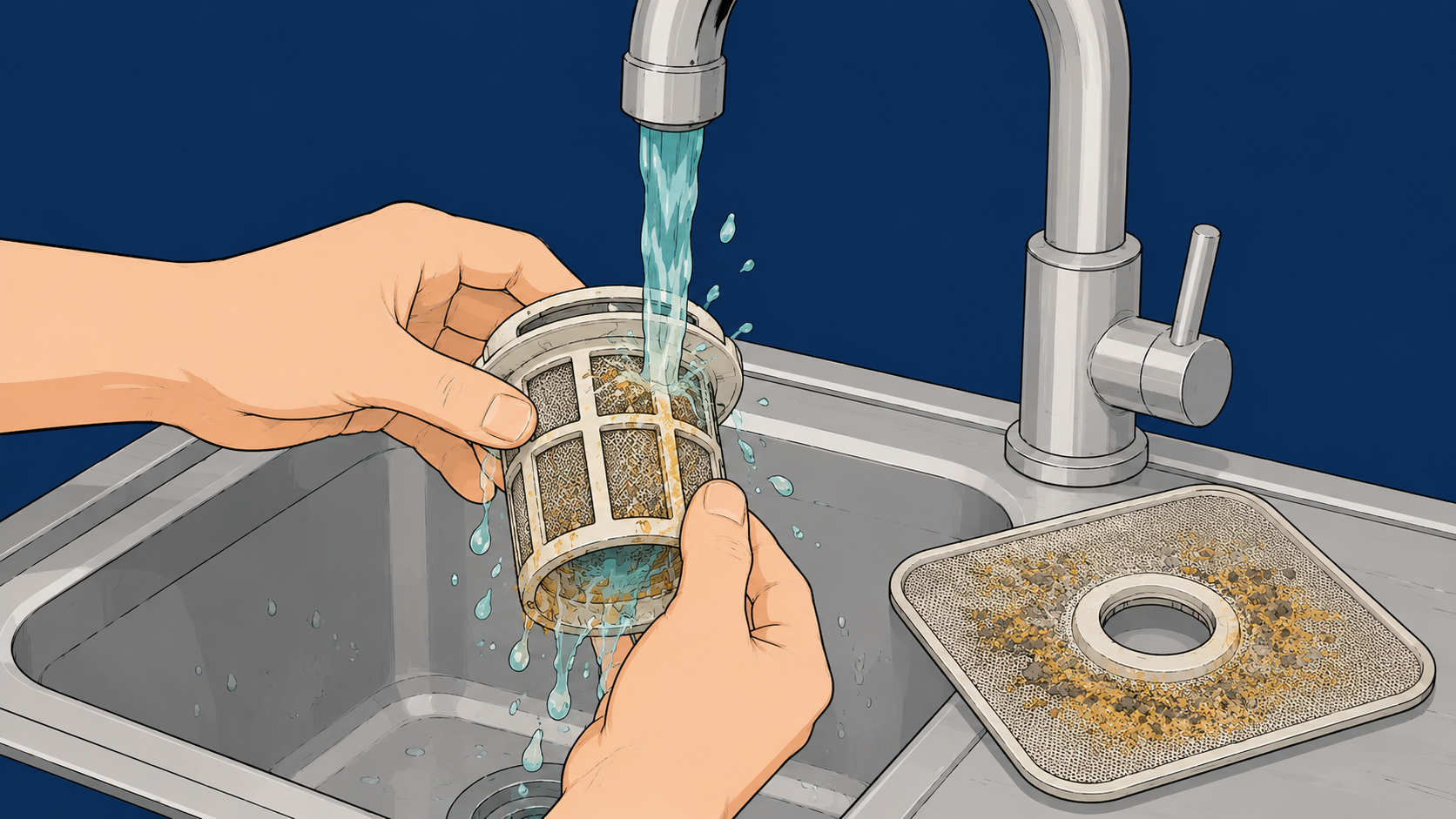
Our 2015 Maytag started leaving standing water after cycles and I spent twenty minutes searching for “Maytag dishwasher not draining” before remembering that Maytag, Whirlpool, KitchenAid, and Amana are all the same platform — same filter location, same pump part numbers, same error codes. Whatever fixes the Whirlpool fixes the Maytag. The filter was clogged on both counts.
A Whirlpool dishwasher that won’t drain is almost always a clogged filter, a kinked drain hose, or a failed drain pump. On Whirlpool-platform dishwashers — which includes Maytag, KitchenAid, and Amana — the filter is a single cylindrical unit at the bottom center of the tub. Clean it first. It fixes Whirlpool drainage problems in about 65% of cases.
What makes Whirlpool different — and what it shares with three other brands
Whirlpool Corporation manufactures dishwashers under four brand names: Whirlpool, Maytag, KitchenAid, and Amana. The internal components — filter assembly, drain pump, motor, spray arms, and most error codes — are shared across all four. If you own a Maytag MDB series, a KitchenAid KDTE series, or an Amana ADB series, this guide applies to your machine too.
The practical implication: drain pump part number W10348269 fits Whirlpool, Maytag, and many KitchenAid models made between 2010 and 2020. When I replaced the drain pump on our 2015 Maytag MDB7749SBM, the part I ordered was listed under Whirlpool first and Maytag second. Same motor, same impeller, same connector. Knowing this saves significant time when ordering replacement parts.
Whirlpool’s filter system uses a single cylindrical unit — simpler than Bosch’s two-piece system, but it clogs just as reliably. The filter tends to accumulate a harder, more compacted debris layer than Frigidaire or Bosch because of the coarser mesh — it looks cleaner at a glance but has less surface area for water to pass through.
Fix 1: Clean the filter — including the part underneath
Pull the bottom rack out. At the center or center-rear of the tub floor, you’ll see a cylindrical filter with a small handle or raised tab. Twist counterclockwise about a quarter turn and lift straight out.
On most Whirlpool models there’s also a flat coarse filter screen underneath the cylinder — it sits flush with the tub floor and either lifts out or snaps up. This piece traps larger debris before it reaches the fine filter. Clean both. The flat screen is the piece most people leave in place and wonder why the drainage problem comes back in two months.
Rinse both pieces under hot running water. Scrub the cylindrical mesh with a soft brush and dish soap. Reinstall the flat screen first, then seat the cylinder and lock clockwise. Run a quick cycle. On our 2015 Maytag — which shares this exact filter system — this was all it needed after 18 months of daily use. If you own a Whirlpool Gold Series: the filter is in the same location but uses a slightly larger cylindrical unit with a more pronounced twist-lock mechanism. The cleaning process is identical.
Fix 2: Check the drain hose — the high loop issue
Whirlpool’s drain hose installation guide specifies a high loop — the hose must arc up to within two inches of the underside of the counter before coming down to the disposal or drain tailpiece. Open the cabinet under the sink and trace the drain hose from the dishwasher. If it runs straight across without the loop, that’s your drainage problem — particularly if you’re seeing intermittent standing water that varies in depth from cycle to cycle. Re-route with a zip tie to the top of the cabinet interior. Costs nothing, takes ten minutes.
Also check the hose for kinks. Whirlpool drain hoses are about 5/8 inch inner diameter and fully corrugated — they kink more readily than Bosch’s semi-rigid hose when pushed flat by items stored under the sink.
Fix 3: Whirlpool dishwasher not draining but no blockage — check the door latch
This is the specific scenario most “no blockage” searches are about — filter is clean, hose is clear, standing water persists. The most common cause: a door latch that doesn’t register as fully closed, causing the cycle to abort before the drain phase runs. On Whirlpool models this happens gradually as the latch wears — the door closes and latches physically but the microswitch inside the latch assembly doesn’t make full contact with the door strike.
Test it: hold the door firmly closed with slight inward pressure during the last few minutes of a cycle. If it drains with pressure applied, the latch assembly needs replacement. Whirlpool door latch assemblies run $15–$35 (part W10250160 and model-specific equivalents). Replacement takes about 20 minutes.
Second most common “no blockage” cause: a cycle interruption. If someone opened the door mid-cycle — even briefly — most Whirlpool dishwashers stop and don’t resume from where they left off. The pump phase never runs. Close the door firmly and run a new short cycle before assuming anything is broken.
Fix 4: Test the drain pump
If the filter is clean, the hose is clear, and the latch is working, the drain pump is the next check. With the dishwasher unplugged, remove the filter and sump cover. Reach into the sump and try to spin the impeller with your finger. On our 2015 Maytag I found a piece of broken spray arm that had jammed the impeller — the spray arm had cracked, a fragment fell into the sump, and that was it. Removing the fragment cleared the problem immediately.
If the impeller spins freely but the dishwasher still won’t drain, test the motor with a multimeter set to resistance. Whirlpool drain pump motors read 5–30 ohms at full function. An OL reading means the windings have failed. Replacement pump assembly W10348269 runs about $40 on PartSelect and fits most Whirlpool, Maytag, and KitchenAid models from 2010–2020.
Fix 5: Check for error codes
Whirlpool dishwashers don’t always display drain error codes on the panel — many models use a flashing light sequence instead of a numeric code. On models with displays, look for F8 E1 or F9 E1 — both indicate a drain issue detected by the control board. On models without a display: the Clean light flashing 7 times in a repeating sequence is a drain error — the board detected that water didn’t leave the tub within the expected time window.
To attempt a drain reset on most Whirlpool models: press Cancel/Drain and hold for three seconds. This forces a drain cycle. If water exits, the issue was a cycle error. If nothing happens, work through Fixes 1–4 above.
When to call a technician
Call a licensed appliance tech if the drain pump impeller is clear, the motor tests OL on a multimeter, and the dishwasher is over 10 years old. At that age, a pump replacement approaches $175–$225 total with labor, and a tech can assess honestly whether repair makes economic sense. Also call if water backs up into the sink drain after the cycle — that’s a plumbing issue, not a dishwasher issue. Work through the pre-call checklist before booking anyone. For every cause of dishwasher drainage failure across all brands, see the complete diagnosis guide.
Frequently asked questions
Why is my Whirlpool dishwasher not draining but there’s no blockage?
The most common cause is a door latch microswitch that doesn’t fully engage — the cycle aborts before the drain phase. Hold the door firmly closed during the last few minutes of a cycle. If it drains with pressure, replace the latch assembly (W10250160, $15–$35). Also rule out a cycle interruption: close the door firmly and run a new short cycle before assuming a mechanical failure. Use the diagnosis tool if you’re still unsure.
Where is the filter on a Whirlpool dishwasher?
At the center or center-rear of the tub floor, under the lower spray arm. It’s a cylindrical unit that twists counterclockwise about a quarter turn to remove. There’s also a flat coarse filter screen underneath — lift it out and clean both pieces together. The flat screen is what most people miss.
Do Whirlpool and Maytag dishwashers use the same parts?
Yes — Whirlpool Corporation manufactures Maytag, KitchenAid, and Amana dishwashers on the same platform. Drain pump W10348269 fits most Whirlpool, Maytag, and KitchenAid models from 2010–2020. When ordering parts, search your model number on PartSelect or RepairClinic — Whirlpool-platform parts almost always list multiple brand compatibilities.
What does 7 flashes mean on a Whirlpool dishwasher?
The Clean light flashing 7 times in a repeating sequence indicates a drain error — the control board detected that water didn’t leave the tub within the expected time window. Start with the filter, then check the drain hose and pump impeller. Press Cancel/Drain for three seconds to force a drain cycle.
Whirlpool Gold Series dishwasher not draining — is it different?
The Gold Series uses the same filter system and drain pump as standard Whirlpool models — the filter cylinder is slightly larger with a more pronounced twist-lock mechanism, but the cleaning process and diagnostic sequence are identical. The door latch microswitch issue appears slightly more often on Gold Series models, likely due to heavier door weight stressing the latch over time.
One hundred and six search results for 4,400 monthly searches — this SERP is practically empty. The shared-platform insight alone makes this guide more useful than anything currently ranking. Clean the filter, check the high loop, hold the door closed. You’ll solve it before you need a multimeter.
Let's Find the Guide.