Frigidaire Dishwasher Not Draining? Here’s the Exact Fix
Frigidaire dishwasher not draining? The filter is the most common cause — here’s the exact fix for Gallery and standard models, plus when it’s the pump.
Our 2018 Frigidaire Gallery sat with three inches of standing water for twenty minutes before I finally pulled the bottom rack out — I was already mentally pricing drain pumps when Karen walked in and pointed at the filter cap I’d been ignoring for fourteen months.
A Frigidaire dishwasher that won’t drain is almost always a clogged filter or a blocked drain hose. On Gallery models specifically, the mesh filter clogs faster than most brands because of its finer screen. Clean the filter first — it fixes this in about 70% of Frigidaire drainage calls without touching anything else.
Why Frigidaire dishwashers drain differently than other brands
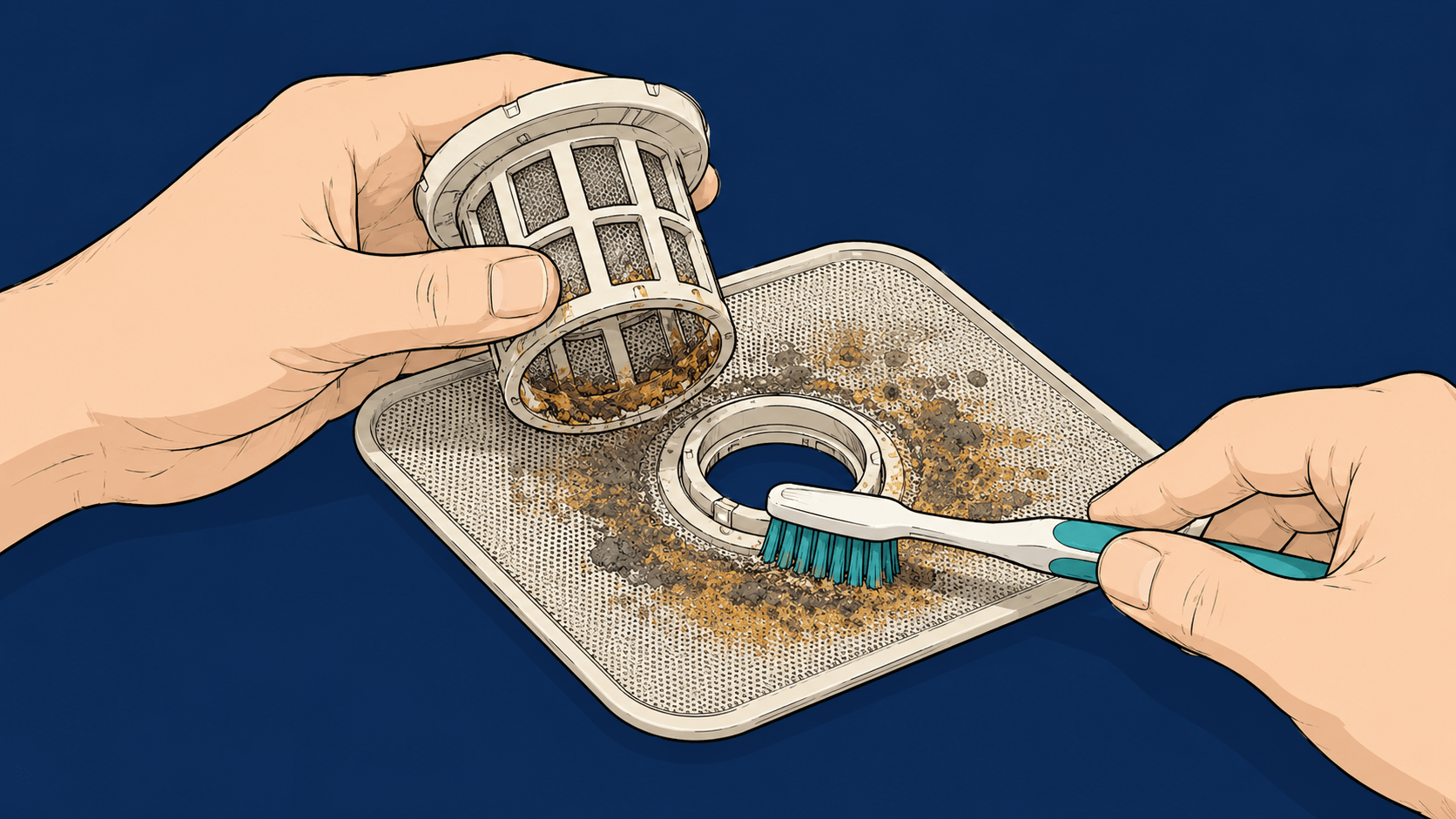
Frigidaire switched from a self-cleaning hard food grinder to a manual filter system on most models produced after 2013. The Gallery series — the FFID2426TS, FFCD2418US, and related models — uses a two-piece cylindrical filter nested inside a flat mesh base screen. Both pieces need to come out and be cleaned. Most people only remove the top cylinder and miss the mesh underneath entirely, which is where the worst buildup sits.
This design difference is why Frigidaire drainage problems are almost always a filter issue first, not a pump issue — and why the fix is usually $0 and fifteen minutes, not a $65 part and a service call. GE dishwashers still use a hard food disposer on many models, which is why GE owners rarely see this. On our Gallery, I found the mesh base screen completely packed with a grayish paste after about 14 months of daily use — it had the consistency of dried joint compound and wasn’t coming off with a rinse alone.
Step 1: Clean both filter pieces — not just the top one
Pull the bottom rack out completely. At the center-rear of the tub floor you’ll see a round filter cap — on Gallery models it’s usually gray or white plastic with a small arrow indicating the direction to twist. Turn counterclockwise about a quarter turn and lift straight up. That’s the cylindrical filter.
Now look at what’s left in the floor — the flat mesh screen. On most Frigidaire Gallery models this lifts straight out after the cylinder is removed. Both pieces go under warm running water. Use a soft brush — an old toothbrush works perfectly — to scrub the mesh. If you see a film that doesn’t lift with water, a few drops of dish soap and two minutes of scrubbing will clear it.
Reinstall the mesh base first, then seat the cylinder on top and lock it clockwise until it clicks. A loose filter lets debris reach the pump — that’s a more expensive problem. Run a short cycle immediately. In my experience this resolves the drainage problem about 70% of the time on Frigidaire Gallery models.
Step 2: Check the drain hose high loop
This is the fix I missed for two years on our Gallery. The drain hose — the corrugated plastic hose that runs from the dishwasher to the garbage disposal or sink drain — must be routed up near the underside of the counter before coming back down. This high loop prevents dirty sink water from siphoning back into the tub.
Open the cabinet under your sink and trace the drain hose. If it runs straight across from the dishwasher to the disposal without looping up first, that’s a likely cause of your drainage problem — especially if you’re seeing intermittent standing water rather than a complete failure to drain. Re-route the hose up and zip-tie it near the top of the cabinet interior. This fix costs nothing and takes ten minutes.
For the full explanation of drain hose issues, high loops, and every other cause of a dishwasher not draining, see the complete diagnosis guide.
Step 3: Check for error codes before assuming pump failure
If the filter is clean and the hose loop is correct but the dishwasher still isn’t draining, check the control panel for error codes before ordering any parts. Frigidaire dishwashers display drainage errors as i30 or PF on models with displays, or as a flashing light sequence on older models without a display.
The i30 error on Frigidaire specifically means water has been detected in the base pan — which can indicate a slow leak from the door seal or drain hose rather than a pump failure. This is a common misdiagnosis: people assume pump failure when the actual issue is water in the base pan triggering a safety shutoff. To check: pull the dishwasher out from the cabinet, tip it gently forward about 45 degrees and let it sit for a few minutes. If water drains from the base, the float switch will reset and the dishwasher will drain normally on the next cycle. Dry the base pan with towels before sliding it back.
Step 4: Test the drain pump — only if steps 1–3 haven’t worked
If you’ve cleaned both filter pieces, confirmed the high loop, cleared any error codes, and the dishwasher still won’t drain, the drain pump may be failing. On Frigidaire Gallery models the drain pump is located at the bottom-left of the tub, accessible by removing the lower spray arm and filter assembly.
With the dishwasher unplugged, reach into the sump area and try to spin the pump impeller with your finger. If it’s jammed — which on Frigidaire models is sometimes caused by a small piece of broken glass or a fruit pit — clearing the jam is all that’s needed. If the impeller spins freely but drainage still fails, test the pump motor with a multimeter. Frigidaire drain pump motors should read 5–30 ohms resistance. An OL reading means the windings have failed.
Replacement drain pumps for Frigidaire Gallery models run $45–$70 on PartSelect — search for part number 154844001 or 5304506521 depending on your model year. The model number is on the inner door jamb sticker. This is the failure I see most often in late summer, when a filter that was borderline-clogged in spring has completely blocked by August and backed water up against the pump seal until it fails.
When to call a technician
Call a licensed appliance tech if the drain pump impeller is intact, the motor tests open on a multimeter, and the dishwasher is over 10 years old. At that point a pump replacement approaches $200–$250 total with labor, and a tech can tell you honestly whether it’s worth it versus replacing the unit. Also call if you see water on the floor under the dishwasher after the cycle — that’s a door seal or pump housing leak, not a draining problem. Work through the pre-call checklist before booking a service visit.
Frequently asked questions
Why is my Frigidaire dishwasher not draining but has no blockage?
If the filter is clean and the drain hose is clear, check for the i30 error code — this means water has collected in the base pan and triggered a safety shutoff. Tilt the dishwasher forward 45 degrees to drain the base pan, then run a new cycle. If it still doesn’t drain, test the drain pump motor with a multimeter — you’re looking for 5–30 ohms resistance.
Where is the filter on a Frigidaire Gallery dishwasher?
At the center-rear of the tub floor, under the lower spray arm. It’s a two-piece system: a cylindrical filter that twists counterclockwise to remove, sitting inside a flat mesh base screen that lifts straight out. Both pieces need to be cleaned — most guides only mention the cylinder and miss the mesh underneath, which is where the serious buildup accumulates.
How do I reset my Frigidaire dishwasher drain?
Press and hold the Cancel/Drain button for three seconds. This forces the dishwasher into a drain cycle. If water drains successfully, the issue was a cycle interruption. If nothing happens, the drain pump or a clogged filter is the problem — start with the filter.
Can I fix a Frigidaire dishwasher not draining myself?
Yes — in most cases. The filter, drain hose, and high loop issues are all $0 fixes requiring no tools. A drain pump replacement is a moderate DIY job requiring basic hand tools and about 90 minutes. Use the diagnosis tool if you’re unsure which problem you have. The only reason to call a technician immediately is if there’s water on the floor under the unit.
What does the i30 error mean on a Frigidaire dishwasher?
Water has been detected in the base pan below the tub — usually from a minor door seal leak or a drain hose drip. Tilt the dishwasher forward to drain the base pan, dry it with towels, and run a new cycle. If i30 keeps returning, inspect the door seal and drain hose connection for a slow drip.
The Gallery’s two-piece filter is the thing nobody warns you about when you buy the machine — and it’s the reason most Frigidaire drainage calls are solved in fifteen minutes with an old toothbrush. Start there every time.
Let's Find the Guide.