GE Dishwasher Not Draining? Check This First (It’s Not the Filter)
GE dishwasher not draining? Most GE models use a hard food disposer, not a filter — here’s the correct diagnosis for GDT, Profile, Nautilus and Café models.
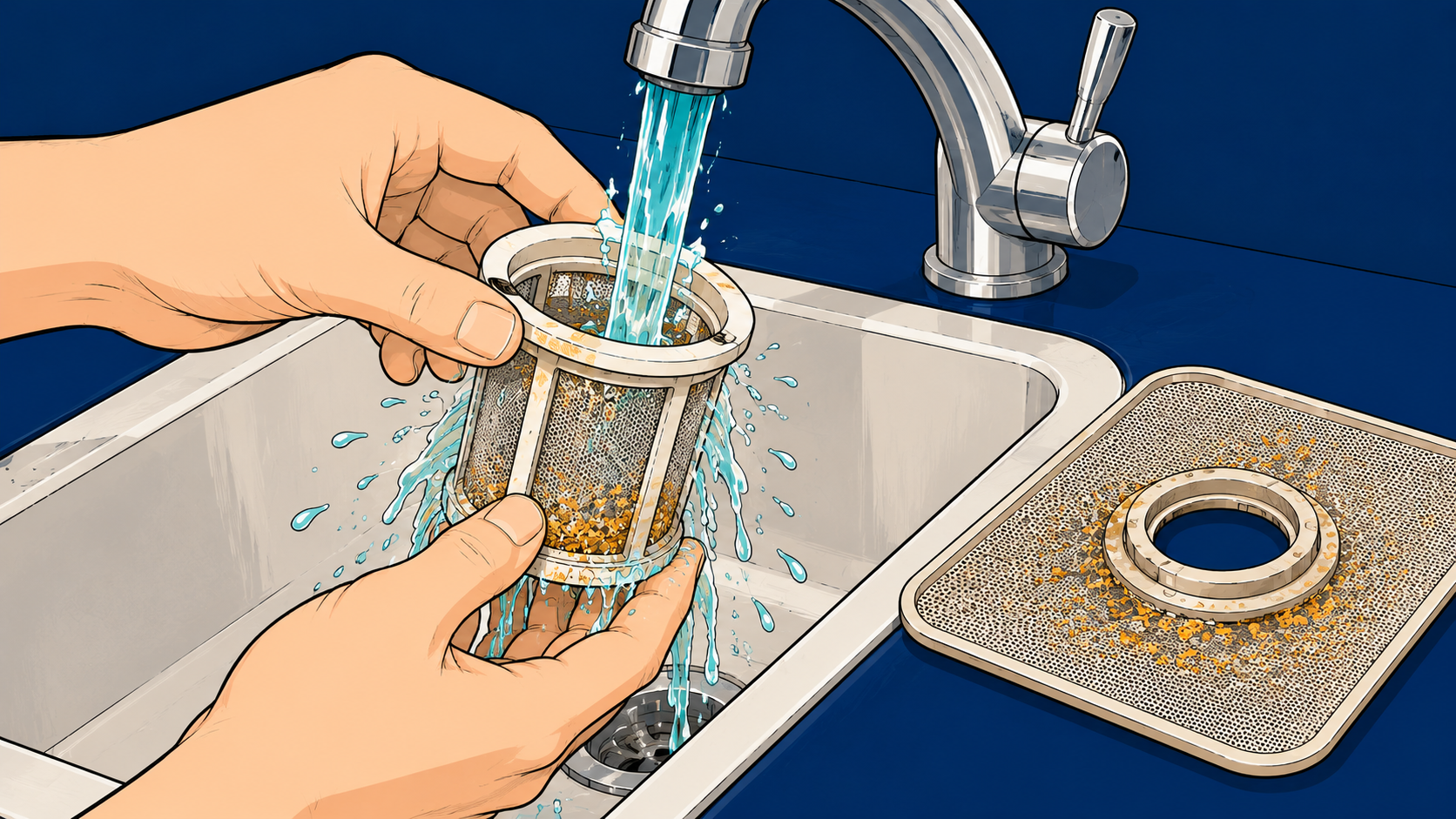
The first time I worked on a GE dishwasher after years of Frigidaire and Whirlpool, I spent ten minutes looking for the filter before realizing there wasn’t one — or at least not the kind I was expecting. Most GE models use a hard food disposer instead, and if that disposer jams, no amount of filter cleaning is going to fix your drainage problem.
A GE dishwasher that won’t drain is most commonly caused by a jammed hard food disposer, a clogged drain hose, or a blocked garbage disposal connection. Unlike Frigidaire and Bosch, most GE dishwashers don’t use a manual filter — they use a self-cleaning grinder that can jam on hard debris. Check the disposer assembly first, not the filter.
Why GE is fundamentally different from Frigidaire, Bosch, and Whirlpool
Frigidaire, Bosch, Whirlpool, LG, and Samsung all switched to manual filter systems after 2010. GE kept the hard food disposer on most of their standard lineup — the GDT series, older Nautilus models, and many Profile models. The disposer is a small shredder inside the sump that grinds food particles so they wash down the drain without clogging. When it works, it’s maintenance-free. When it jams — on a cherry pit, a piece of broken glass, a small bone — it either stops the drain pump from running or blocks drainage entirely.
The symptom looks identical to every other drainage problem: standing water at the end of a cycle, no drainage sound, sometimes a humming noise. The fix is completely different. GE Café models and newer GE Profile dishwashers (2018 onward) have shifted to a filter system — check the bottom of the tub. If you see a round filter cap to twist out, you have a filter model. If you see a flat grille with no twist mechanism, you have a disposer model.
Step 1: Check and clear the hard food disposer
On GE dishwashers with a hard food disposer, the disposer assembly is located at the bottom center of the tub, under the lower spray arm. Remove the bottom rack, then unscrew or unclip the lower spray arm — it usually twists counterclockwise or pulls straight up. Beneath it is the spray arm support and the disposer cover. On most GDT and Nautilus models, the disposer cover lifts off with a quarter turn.
With a flashlight, look into the disposer chamber for anything hard that shouldn’t be there — a cherry pit, a small bone fragment, a piece of broken glass, a toothpick. I’ve found all of these in GE disposers over the years. The worst was a small pebble that had come in on a potato — it had been rattling around for weeks before the disposer finally seized on it.
If you see debris, remove it with needle-nose pliers. Then try to rotate the disposer impeller manually with a finger or a small flathead screwdriver. If it turns freely, reassemble and run a short cycle. If the impeller is seized and won’t turn at all, locate the reset button on the disposer assembly — on most GE models it’s a small red or white button on the underside of the disposer body. Press it firmly to reset the motor thermal overload. Reassemble and run a cycle.
Step 2: Check the garbage disposal connection
GE dishwashers that drain into a garbage disposal are subject to the same knockout plug problem as every other brand — but GE owners hit this more often because GE is one of the most common brands in new construction. If your GE dishwasher recently stopped draining after a new disposal was installed, check the inlet port. Disconnect the drain hose, look inside the inlet with a flashlight. A flat plastic disc blocking the opening means the installer forgot to remove the knockout plug. Knock it out from inside with a screwdriver and a hammer, retrieve the disc, and reconnect the hose.
Even without a new disposal: run the disposal for 30 full seconds before starting the dishwasher. A partially clogged disposal is the single easiest-to-fix GE drainage problem and the one most people don’t try first.
Step 3: GE Profile dishwasher not draining — the filter model fix
Newer GE Profile models (2018 onward) and GE Café models have a filter system rather than a disposer. The filter is a cylindrical screen at the center-rear of the tub floor — twist counterclockwise and lift. Clean both the cylindrical filter and the flat mesh screen beneath it under hot water with a soft brush.
Older Profile models and all Nautilus models use the disposer system described in Step 1. The fastest way to tell: if you see a twist-off cap at the tub floor, it’s a filter model. If you see a flat grille with no obvious removal mechanism, it’s a disposer model. The model number on the door jamb sticker will confirm which generation you have.
Step 4: Check the drain hose and solenoid valve
If the disposer or filter is clear and drainage still fails, check the drain hose routing under the sink. GE dishwashers have a standard corrugated drain hose that can kink behind the unit or inside the cabinet. Pull the dishwasher out slightly, trace the hose, straighten any kinks, and confirm the high loop is in place — the hose should arc up near the underside of the counter before coming back down.
Some older GE models — particularly pre-2015 units — use a drain valve solenoid rather than a direct-drive drain pump. When the solenoid fails, the valve stays closed and drainage is intermittent: the dishwasher drains sometimes and not other times. That pattern of inconsistency is the diagnostic clue. Test the solenoid coil with a multimeter — you’re looking for 200–500 ohms resistance. Outside that range or OL means replacement. GE drain solenoids run $20–$50 and are model-specific.
When to call a technician
Call a licensed tech if the disposer impeller won’t turn after resetting the thermal overload and clearing all debris — the disposer motor itself may have failed. GE disposer assemblies run $35–$75 depending on model. Also call if water backs up into the sink after the cycle even with the disposal cleared — that points to a main drain line blockage, not a dishwasher problem. Work through the pre-call checklist before booking a service visit. For a full breakdown of every dishwasher drainage cause across all brands, see the complete diagnosis guide.
Frequently asked questions
Why does my GE dishwasher not drain but there’s no filter to clean?
Most GE dishwashers use a hard food disposer instead of a manual filter. If there’s no twist-off filter cap on the tub floor, you have a disposer model. Check the disposer chamber for debris — a cherry pit, small bone, or piece of glass is the most common cause. Press the thermal overload reset button on the underside of the disposer body if the impeller won’t spin.
Where is the filter on a GE dishwasher?
Not all GE dishwashers have a manual filter. Standard GDT and Nautilus models use a hard food disposer — look for a flat grille on the tub floor with no twist mechanism. Newer GE Profile models (2018+) and GE Café models have a cylindrical filter that twists counterclockwise at the center-rear of the tub floor.
How do I reset my GE dishwasher drain?
Press and hold the Start/Reset button for three seconds. This initiates a drain cycle on most GE models. If water drains, the issue was a cycle interruption. If nothing happens, the disposer or drain pump is the problem. On disposer models, also check the red thermal overload reset button on the underside of the disposer assembly.
GE Profile dishwasher not draining — is it different from a standard GE?
Newer GE Profile models (2018 onward) use a filter system — clean the cylindrical filter and the flat mesh screen beneath it. Older Profile models use the disposer system. Check the tub floor: a twist-off cylindrical cap means filter model; a flat plastic grille means disposer model.
GE Nautilus dishwasher not draining — what should I check?
Nautilus models all use the hard food disposer system. Remove the lower spray arm, access the disposer chamber, and check for debris. Press the thermal overload reset button on the disposer body. Also check that the drain hose has a proper high loop — Nautilus installations are often older and the original hose routing may have shifted over the years.
The hard food disposer is why GE drainage problems get misdiagnosed more often than any other brand — people follow generic guides that tell them to clean the filter, find there isn’t one, and assume the pump has failed. Check the disposer first. A cherry pit and a reset button have saved more than a few unnecessary service calls.
Let's Find the Guide.